OLYMPIC – ON AIR


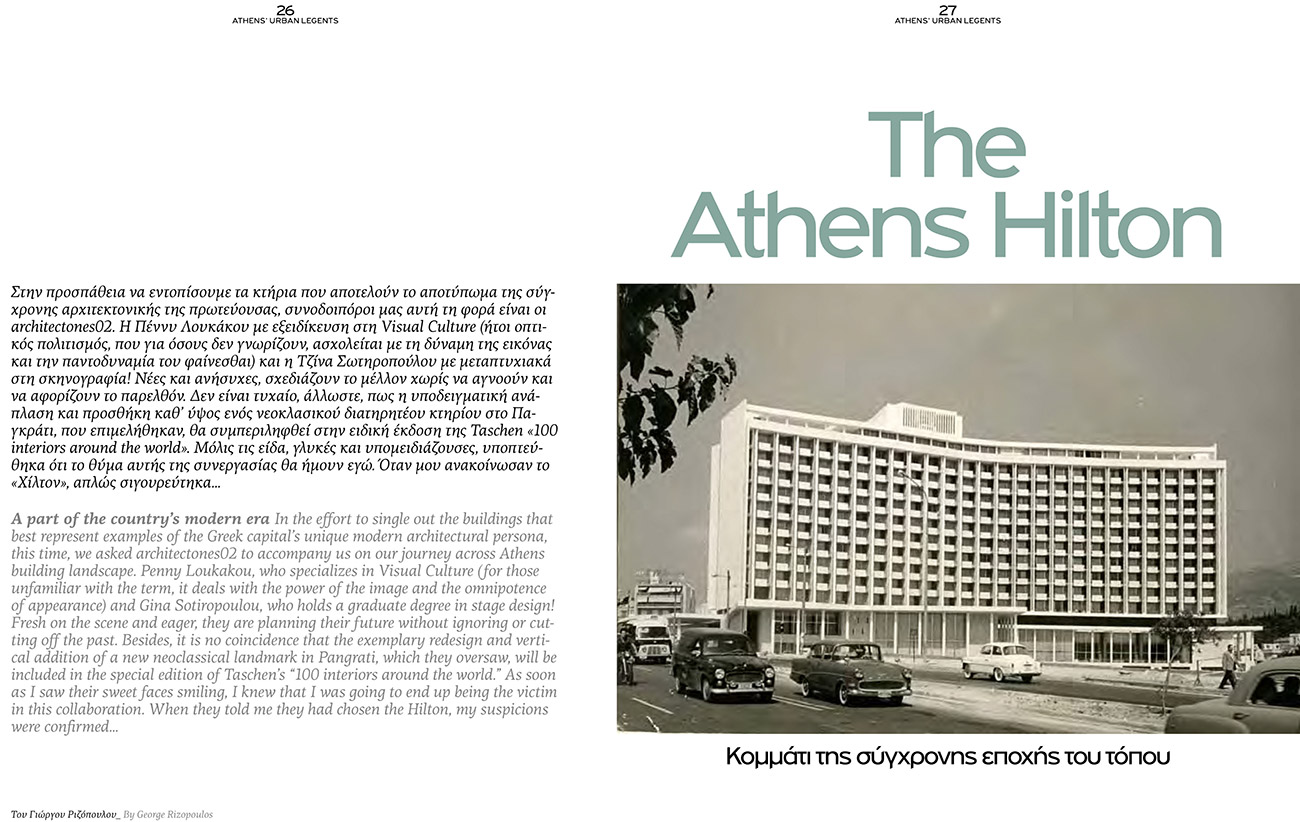
Athens’ Urban Legents | THE ATHENS HILTON: A part of the country’s modern era. In the effort to single out the buildings the best represent examples of the Greek capital’s unique modern architectural persona, this time we asked architectones02 to accompany us on our journey across building landscape. Penny Loukakou, who specializes in Visual Culture (for those unfamiliar with this term, it deals with the power of the image and the omnipotence of appearance) and Tzina Sotiropoulou, who holds a graduate degree in stage design! Fresh on the scene and eager, they are planning their future without ignoring or cutting off the past. Besides, it is no coincidence that the exemplary redesign and vertical addition of a new neoclassical landmark in Pangrati, which they oversaw, will be included in the special edition of Taschen’s “100 Interiors around the world”. As soon as I saw their sweet faces smiling, I knew that I was going to end up being the victim of the victim in this collaboration. When they told me they had chosen the Hilton, my suspicions were confirmed…
Why the Athens Hilton?
“It is a landmark, it has defined the area, and it is the first large -scale building, the first sign of visual elevation in post-war Athens, the first example of an “architecture of prestige” that the citizens and the nation itself so badly needed that time”, Penny said, while reaffirming the power of visual culture. “It is the first building that combined art with architecture, and served as the scenery for a new political reality, which henceforth imposed a “convex, rhythmic modernism” out of its desire to forget the memories of WWII and they subsequent civil war, Tzina added. What she most likely meant to say is that every ambitious or wealthy theater company changes the scenery on the set during the production of a new play.
Greece and Athens in the 50’s
Well, this theater company may not have been wealthy, but it was certainly ambitious.”…and, as opposed to today, we lived in an era where there was a belief that all good things could happen”, Marilena Liakopoulou, daughter of famous artist Pericles Vyzantios and owner of the legendary Hilton Art Gallery, told me with a hint of nostalgia in her voice. “By the end of the 1950’s, we had recovered from the war and gotten back on our feet. Feeling reborn, we lived life like there was no tomorrow”. By the mid-50’s, Omomia and Syntagma squares had both been completely rebuilt, while Vassilissis Sofias Avenue – which was home to al the bourgeoisie mansions and embassies in the city, due to its proximity to the Royal Palace –was linked to power lines and lit for the first time in 1957! Just a little further up, there was a military area that housed the Technical Corps base, and next to it, on the Papadiamantopoulos bridge which stood over the Ilissos riverbed- where Michalakopoulou Street lies today – there was an old neighborhood with immigrants who lived in shacks! Here in this practically unlivable area, Constantine Karamanlis built his vision for the modernization of the country. Conrad Hilton’s decision to invest in a building that was designed by architects who did not belong to his group – a first- in addition to the ease with which the project’s great architects E. Vourekas, P. Vailiadis, and S. Staikos “tackled” this difficult plot of land, legitimized Greek modernism, which had been reproachable up until then. They imposed a monumental building that did not take long to become an object of admiration for not only Athenians, but the building’s owner as well!
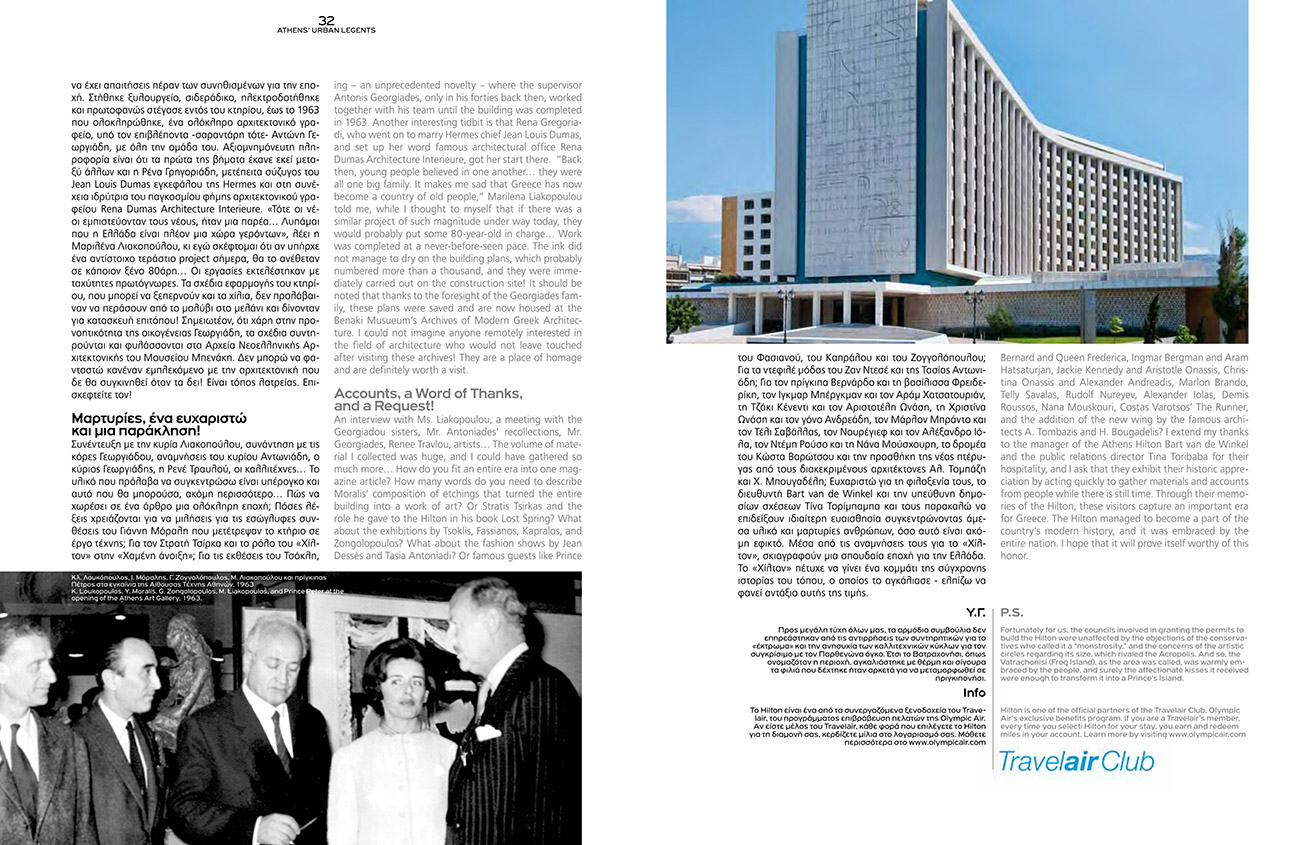
The hollow axes succeeded in lessening the structure’s rigidity and giving a light firmness to a building that was 14 stories high and 120 meters long! The Hilton group limited itself to commissioning the interior design to Warner, Burns, Joane and Winde, thus achieving an ideal combination of contemporary Greek style on the shell and Western opulence in the interior. ”In 1960, there was a very strong up- and- coming urban class. They were cosmopolitan, well traveled, and had an intense need to give a breath of fresh air to the new Athens, which would run counter to the architectural style of their families’ luxurious villas located in the center of Athens or in Kifissia. They sought a modern architecture that would reflect their economic prosperity, and not one that would mirror the prosperity of their grandfathers”, architects Rania and Anna Georgiades, the project architect who oversaw the construction of the Athens Hilton told us.
Classicism Versus Modernism
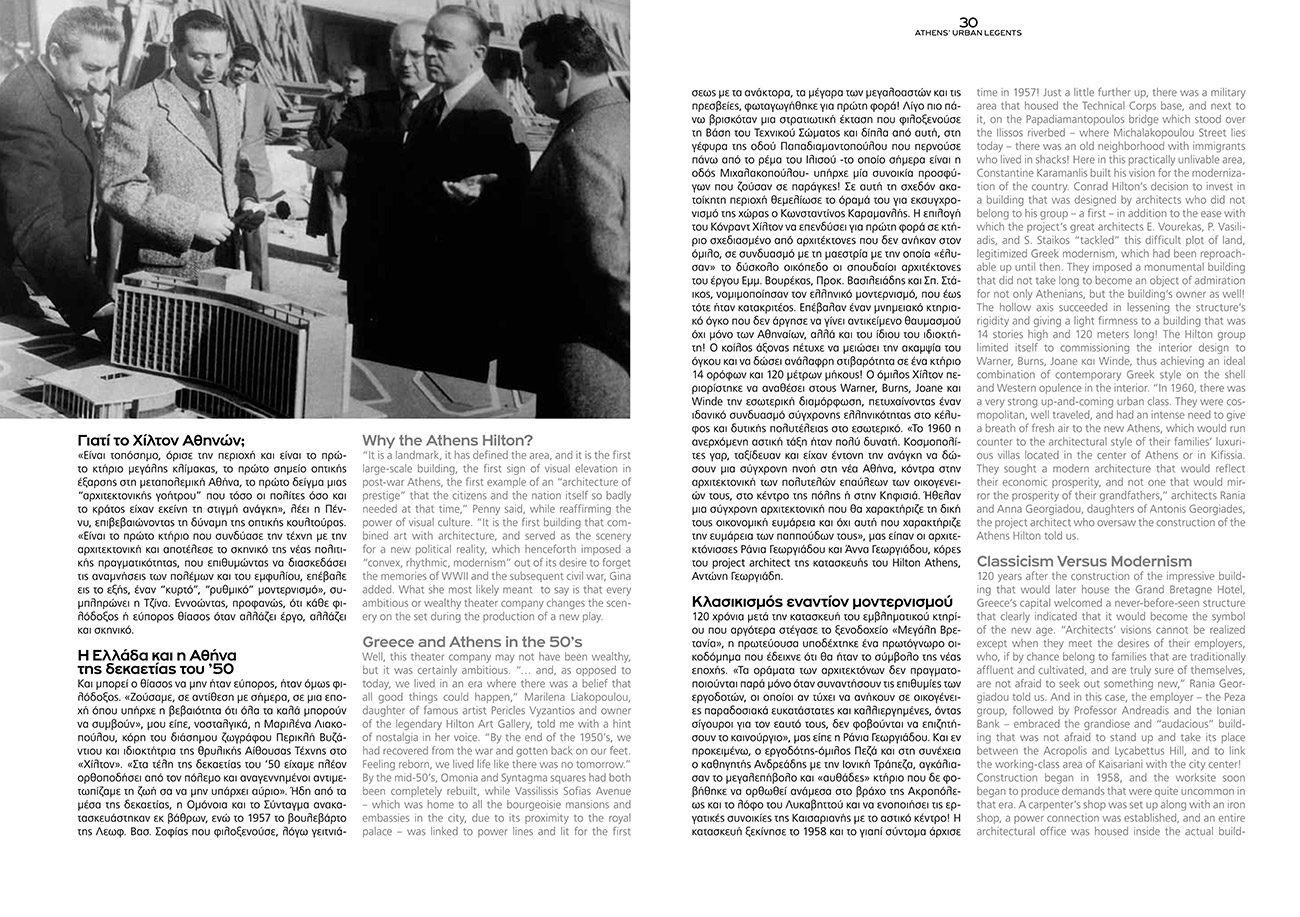
120 years after the construction of the impressive building that would later house the Grande Bretagne Hotel, Greece’s capital welcomed a never- before-seen structure that clearly indicated that it would become the symbol of the new age. “Architects’ visions cannot be realized except when they meet the desires of the employers, who, if by chance belong to families that are traditionally affluent and cultivated, and are truly sure of themselves, are not afraid to seek out something new”, Rania Georgiadou told us. And in this case, the employer – the Peza group, followed by Professor Andreadis and the Ionian Bank – embraced the grandiose and “audacious” building that was not afraid to stand up and take its place between the Acropolis and Lycabettus Hill, and to link the working-class area of Kaisariani with the city center! Construction began in 1958, and the worksite soon began to produce demands that were quite uncommon in that area. A carpenter’s shop was set up along with an iron shop, a power connection was established, and an entire architectural office was house inside the actual building -an unprecedented novelty – where the supervisor Antonis Georgiadis, only in his forties back then, worked together with his team until the building was completed in 1963. Another interesting tidbit is that Rena Gregoriadis, who went on to marry Hermes chief Jean Louis Dumas, and set up her world famous architectural office Rena Dumas Architecture Interieure, got her start there. “Back then, young people believed in one another… they were all one big family. It makes me sad that Greece has now become a country of old people”, Marilena Liakopoulou told me, while I thought to myself that if there was a similar project of such magnitude under way today, they would probably put 80- year- old in charge… Work was completed at a never- before-seen pace. The ink did not manage to dry on the building plans, which probably numbered more than a thousand, and they were immediately carried out on the construction site! It should be noted that thanks to the foresight of the Georgiades family, these plans were saved and are now housed at the Benaki Museum’s Archives of Modern Greek Architecture. I could not imagine anyone remotely interested in the field of architecture who would not leave touched after visiting these archives! They are a place of homage and are definitely worth a visit. GIORGOS RIZOPOULOS